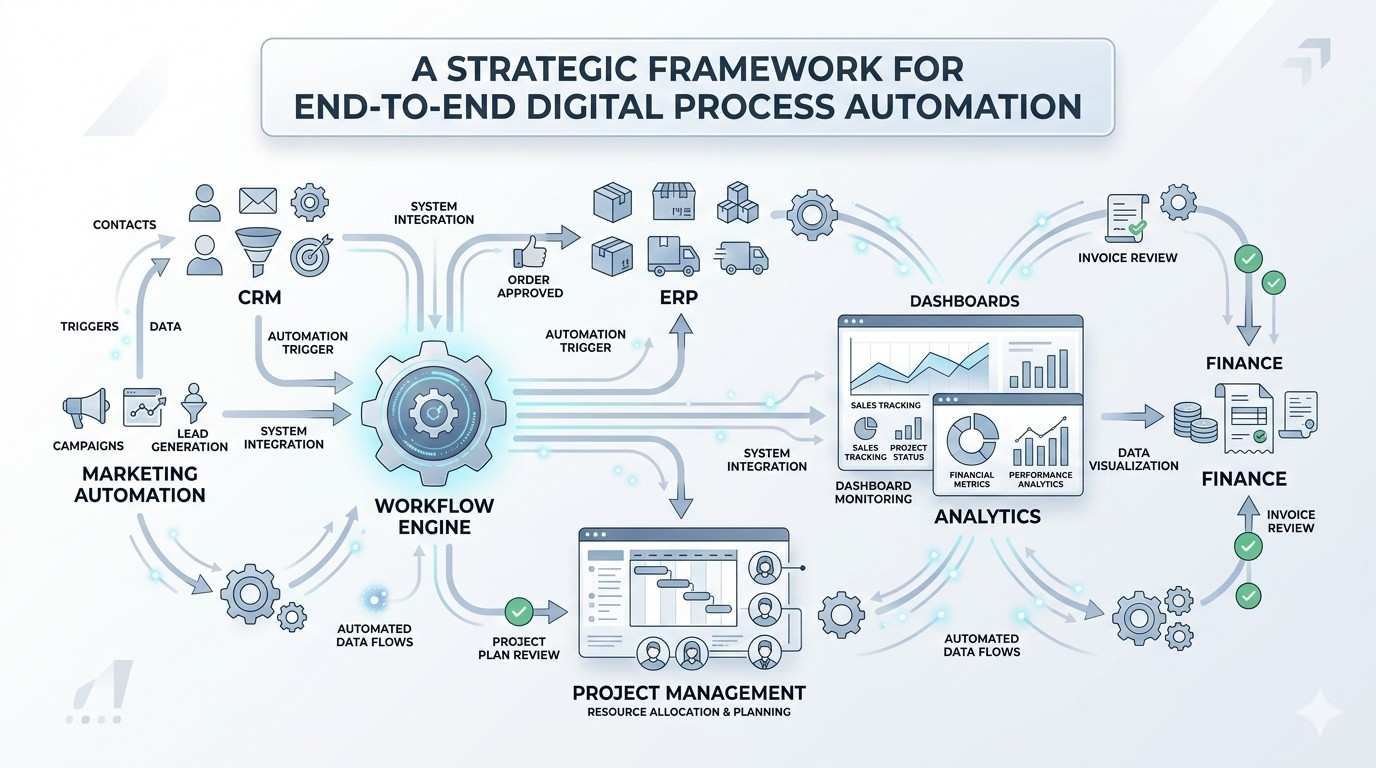
Digital transformation has evolved beyond simple system upgrades. Organizations now aim to automate complete business processes from initiation to outcome. However, automation without strategy often creates fragmented workflows. Therefore, a structured framework becomes essential for end-to-end digital process automation.
End-to-end automation connects people, systems, and data across departments. It eliminates manual handoffs and reduces operational delays. Moreover, it ensures transparency across the entire lifecycle of a transaction. When implemented strategically, automation drives efficiency, accuracy, and scalability.
Yet, many businesses struggle with disconnected platforms. For example, project management tools and CRM systems often operate independently. When companies implement an Asana Salesforce Integration, they aim to align sales activities with execution workflows. However, without a broader automation framework, such integrations may only solve isolated problems. Consequently, a strategic approach must guide every integration decision.
Defining End-to-End Digital Process Automation
End-to-end digital process automation refers to orchestrating complete workflows using technology. It connects upstream and downstream activities into a seamless experience. Instead of automating isolated tasks, organizations automate entire value chains.
For instance, consider a customer acquisition process. It begins with marketing engagement and ends with post-sale support. Each stage involves multiple systems and stakeholders. Therefore, automation must coordinate data flow, task assignment, and approvals across all systems.
Furthermore, automation should enhance visibility. Leaders require real-time dashboards. Teams need clarity on responsibilities. Customers expect consistent communication. Thus, automation must integrate operational logic with user experience.
Why Automation Initiatives Often Fail
Despite significant investment, automation projects frequently underperform. One reason is lack of process clarity. Organizations attempt to automate poorly defined workflows. As a result, inefficiencies become digitized instead of eliminated.
Another common issue is siloed implementation. Departments implement automation tools independently. However, these tools rarely communicate effectively. Consequently, data fragmentation increases.
Additionally, governance gaps create risks. Without defined ownership and oversight, automation rules become inconsistent. Over time, this inconsistency undermines trust in digital systems. Therefore, governance must accompany automation efforts.
Core Pillars of a Strategic Automation Framework
A robust framework for digital process automation rests on several foundational pillars.
1. Process Discovery and Mapping
Automation begins with understanding current workflows. Organizations must map each step, decision point, and system interaction. This mapping reveals redundancies and bottlenecks.
Moreover, process discovery should involve cross-functional teams. Sales, operations, finance, and support often influence the same workflow. Therefore, collaboration ensures alignment.
Clear documentation enables future optimization. Without documented baselines, measuring improvement becomes impossible. Thus, process mapping establishes strategic clarity.
2. Business Outcome Alignment
Automation must align with measurable objectives. These objectives may include revenue growth, cost reduction, or customer satisfaction improvement. Without defined goals, automation efforts drift.
For example, if the goal is faster deal execution, automation should reduce approval delays. If the goal is compliance, workflows should enforce validation rules. Therefore, every automation initiative must connect to strategic outcomes.
Alignment also helps prioritize investments. Not all processes require immediate automation. High-impact workflows should receive priority.
3. System Integration Strategy
Modern enterprises rely on diverse technology stacks. CRM systems manage customer interactions. ERP platforms handle financial transactions. Collaboration tools support internal coordination. Consequently, automation requires seamless integration across these systems.
A clear integration strategy defines data flow direction and ownership. It also determines synchronization frequency. Real-time integrations support dynamic processes. However, batch integrations may suffice for reporting.
Middleware solutions often simplify orchestration. They centralize transformation logic and error handling. However, governance must define system authority boundaries. Otherwise, integration complexity increases.
4. Data Governance and Quality Controls
Automation relies heavily on data accuracy. Inconsistent or incomplete data disrupts workflows. Therefore, data governance frameworks must support automation initiatives.
Field-level validation prevents incorrect inputs. Approval hierarchies enforce compliance. Audit logs provide traceability. Additionally, role-based access controls protect sensitive information.
Data standards should remain consistent across systems. For example, customer status definitions must match across CRM and ERP platforms. Consistency ensures reliable automation triggers.
5. Workflow Orchestration and Logic Design
Workflow orchestration defines how tasks move across systems. It determines triggers, conditions, and escalation paths. Therefore, careful design prevents unintended consequences.
Conditional logic enhances flexibility. For example, high-value deals may require executive approval. Smaller transactions may follow simplified workflows. This differentiation optimizes efficiency.
Escalation mechanisms address delays. If tasks remain pending beyond defined thresholds, automated reminders activate. Such controls maintain accountability.
Moreover, orchestration tools should offer visual workflow builders. Clear visualization simplifies governance reviews. It also reduces configuration errors.
6. Change Management and User Adoption
Even well-designed automation fails without user adoption. Employees must understand new workflows. Training programs should accompany implementation.
Communication plays a crucial role. Leaders must explain benefits and expectations. Additionally, feedback channels allow continuous improvement.
Resistance often stems from fear of disruption. Therefore, phased rollouts reduce anxiety. Early success stories encourage broader acceptance.
User experience design also matters. Intuitive interfaces increase engagement. Complex dashboards discourage participation. Hence, usability supports sustainability.
7. Performance Monitoring and Optimization
Automation is not a one-time project. Continuous monitoring ensures effectiveness. Key performance indicators measure efficiency, accuracy, and cycle time.
Dashboards provide real-time insights. Leaders can identify bottlenecks quickly. Analytics reveal trends and anomalies.
Furthermore, periodic reviews enable optimization. As business strategies evolve, workflows must adapt. Automation frameworks should support agility.
Integration Patterns Within the Framework
Different integration patterns influence automation success.
One-way synchronization ensures clear system authority. It works well when one system owns specific data domains. Bi-directional synchronization requires conflict resolution logic.
Event-driven architectures enable responsive workflows. When a trigger occurs, connected systems update immediately. However, event-driven models require robust monitoring.
API-based integrations offer flexibility. They support modular architectures. However, governance must oversee API usage and security.
Therefore, integration patterns should align with process complexity and risk tolerance.
Risk Management in Digital Automation
Automation introduces both efficiency and risk. Therefore, risk management must remain central.
Operational risks include workflow failures and system downtime. Redundancy strategies mitigate these risks. Backup processes ensure continuity.
Compliance risks require strict controls. Automated workflows must align with regulatory requirements. Audit capabilities support accountability.
Cybersecurity risks also increase with interconnected systems. Secure authentication and encryption protect sensitive data.
Proactive risk assessment reduces exposure. Regular testing identifies vulnerabilities before escalation.
Building a Scalable Automation Roadmap
A phased roadmap ensures sustainable progress. Organizations should prioritize high-impact processes first. Early wins build momentum.
Next, scalability considerations guide technology selection. Platforms should accommodate growth. Flexible architectures support expansion.
Additionally, governance frameworks must scale with complexity. Clear ownership models prevent confusion. Documentation ensures knowledge continuity.
Investment planning also matters. Automation requires resources for maintenance and upgrades. Long-term budgeting supports resilience.
Real-World Application Scenario
Consider a mid-sized enterprise seeking operational efficiency. Sales closes deals in CRM. Operations manages project delivery. Finance handles invoicing.
Previously, manual emails connected these departments. Delays occurred frequently. Data inconsistencies created billing disputes.
After implementing a strategic automation framework, workflows became seamless. Deal closure triggered automatic project creation. Task assignments followed predefined templates. Finance received validated billing details instantly.
Performance metrics improved significantly. Cycle times decreased. Error rates declined. Leadership gained real-time visibility across departments.
This example demonstrates how structured automation enhances coordination. It transforms isolated systems into a unified ecosystem.
Conclusion
End-to-end digital process automation demands more than tool deployment. It requires strategic alignment, governance clarity, and integration discipline. Organizations must map processes carefully and define measurable objectives.
Integration strategies should align with data ownership and workflow logic. Governance controls must ensure accuracy and compliance. Additionally, user adoption strategies guarantee sustainability.
When implemented thoughtfully, automation drives operational excellence. It enhances transparency and accelerates decision-making. Moreover, it strengthens collaboration across departments.
Ultimately, a strategic framework transforms automation from a tactical initiative into a competitive advantage. Businesses that embrace structured automation position themselves for scalable growth and long-term resilience